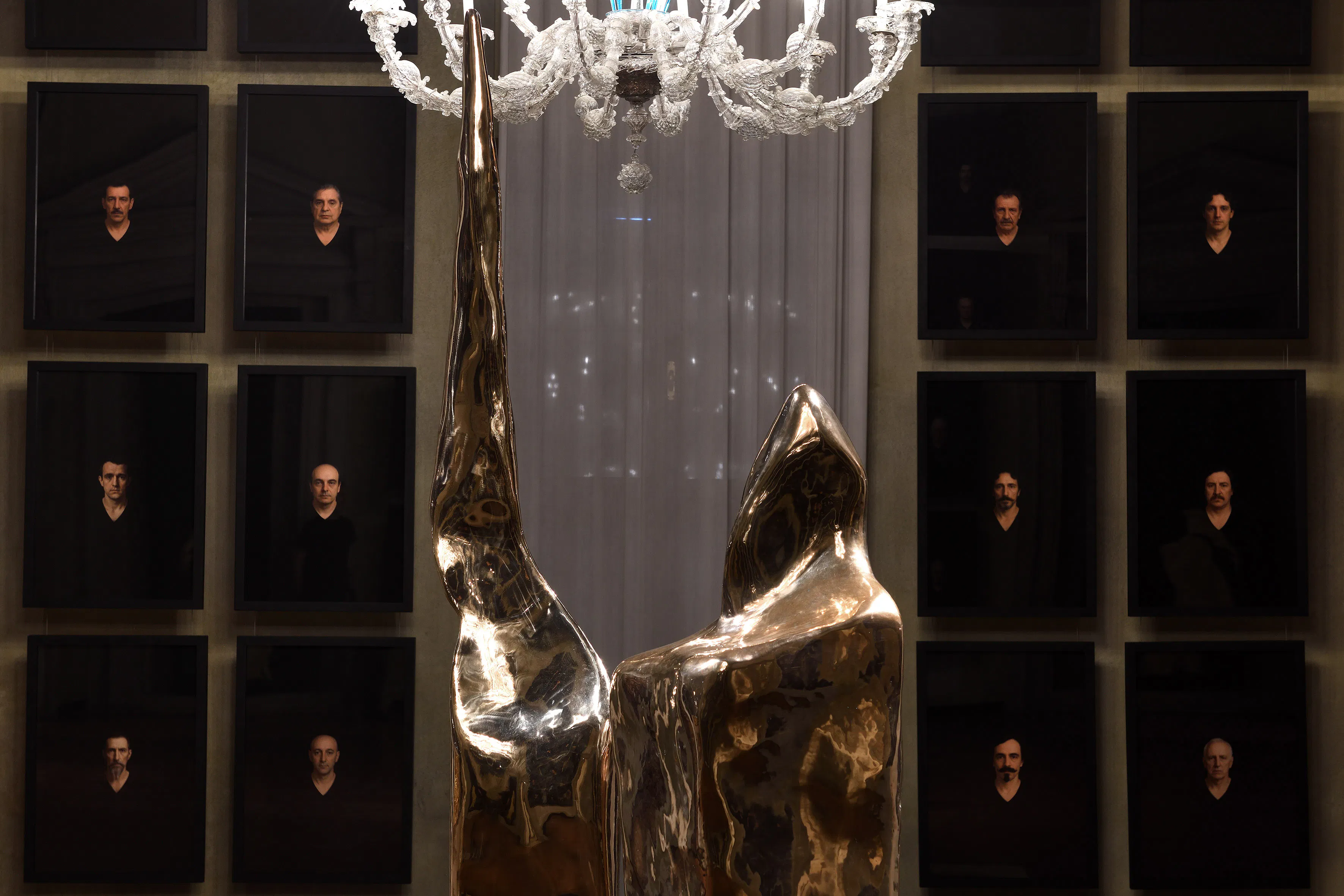
The Prince. The Nightwalker of Magmatic Thought
Bizhan Bassiri – Museo Correr
by Francesca Carol Rolla
Head of PR & Cultural Advocacy, We Exhibit
Museo Correr. The heart of Venice.
Rooms that hold centuries like strata of rock: corridors, sedimentations, passages.
History here is not a mere frame. It is living matter.
Matter holding an ancient vibration, on the verge of becoming a threshold.
Bizhan Bassiri opens a fissure in the substance of time.
He calls it The Prince. The Nightwalker of Magmatic Thought.
Credits: Michele Alberto Sereni
In his lexicon — cosmological and intimate, like the night when it slowly becomes knowledge — the Nightwalker is “the damned one who gives body to his prophecies.”
In a vibrating silence, I find myself immersed in a field of resonances.
I am the witness.
A slow oscillation moves through me, and I find myself a guest in this temple.
A place where ghosts acquire form and stones seem to breathe a secret life.
An underground current runs through the museum and gently draws the visitor toward a single chamber.
The works that precede that chamber do not appear as a simple chronological sequence.
They belong to a slow approach, like ancient images rising from history and accompanying the path.
They do not explain.
They prepare the apparition.
Credits: Michele Alberto Sereni
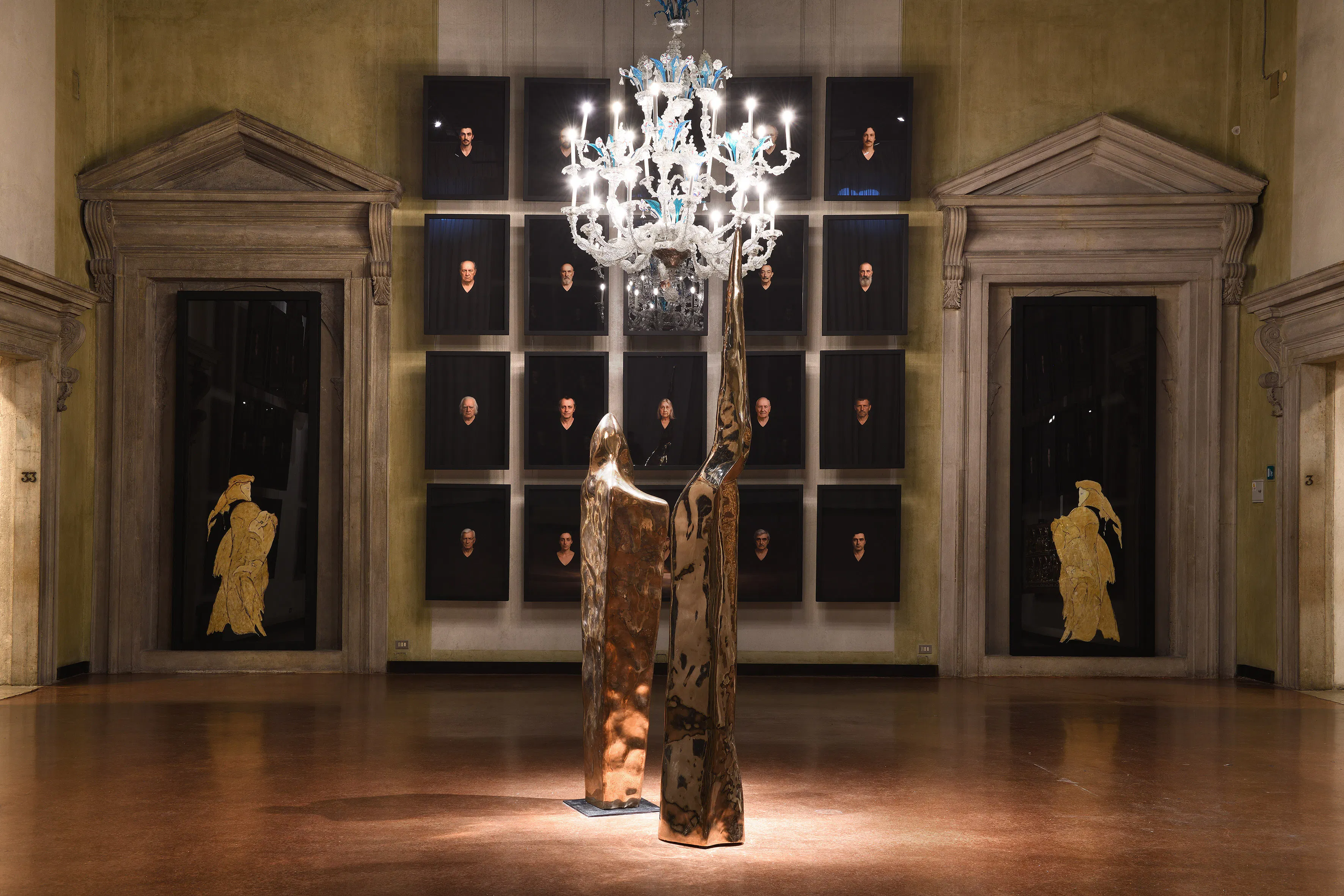
And then The Prince. The Nightwalker of Magmatic Thought opens.
It opens as a constellation.
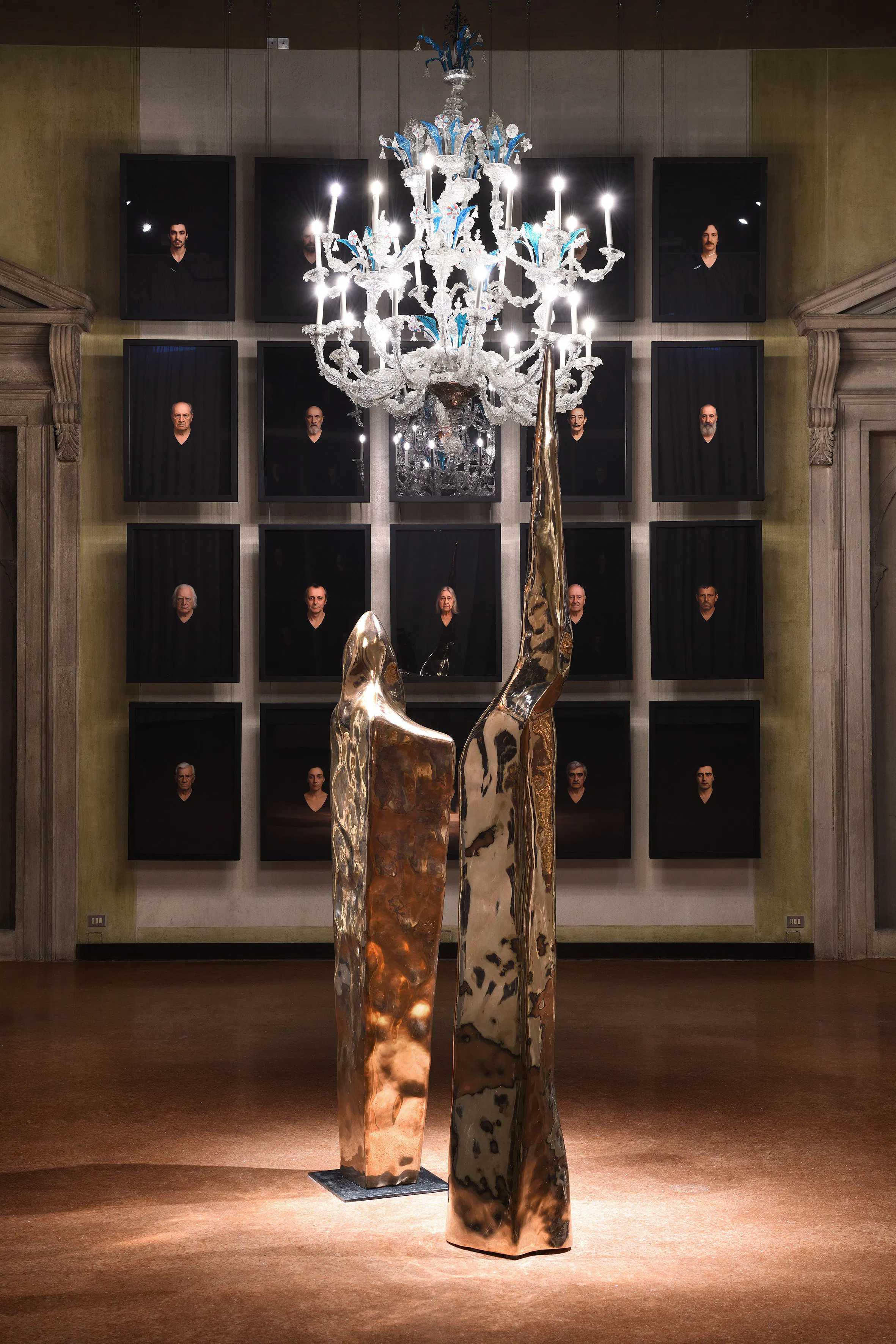
At the centre, a meteorite rises.
The gaze comes to rest there first.
Bronze. Dense matter.
A generative verticality.
An axis that seems to precede form, as if every form were the manifestation of a deeper pressure — an energy asking to emerge.
This cosmic pivot holds the room in balance and quietly disorients it.
The meteorite arrives.
It settles.
It holds.
From that point, it radiates.
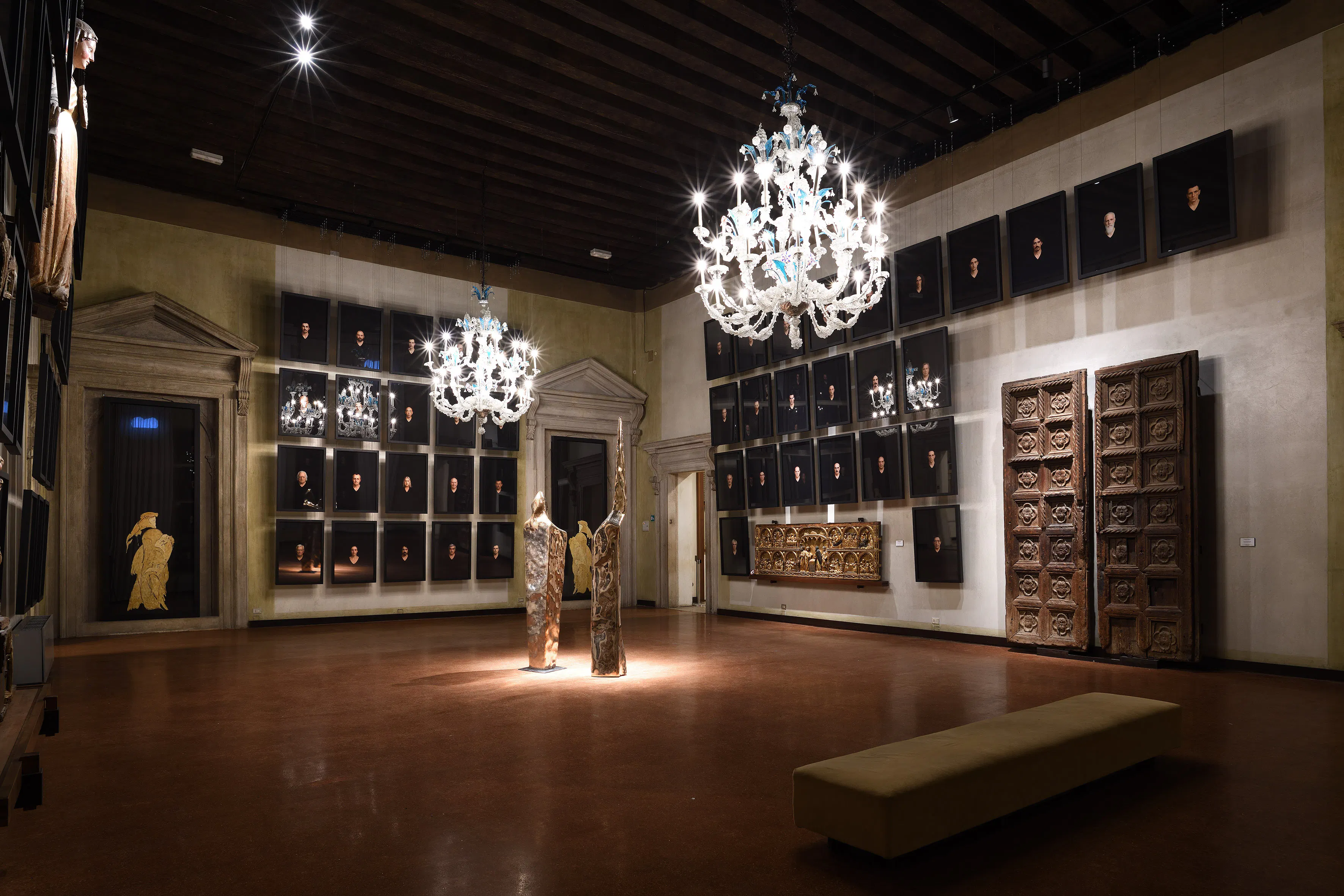
Around it, along the walls, the gallery unfolds like a map of history and destiny.
Credits: Michele Alberto Sereni
Ninety portraits.
Ninety presences.
A genealogy crossing centuries — from the Renaissance to the present.
Faces emerge and inhabit the space like a cosmogony growing in height.
From the lowest levels to the summit of the walls, an ascending trajectory.
Almost a genealogical tree of art history that does not arrange itself in a straight line, but through invisible proximities, attractions, and resonances.
Bassiri writes that the Prince dwells among the arches of the Hall of the Four Doors, illuminated by glass chandeliers blown by the winds of dawn.
Above, the Erme guardian — the spinal column of the space — keeps watch in silence over the sovereign quiet.
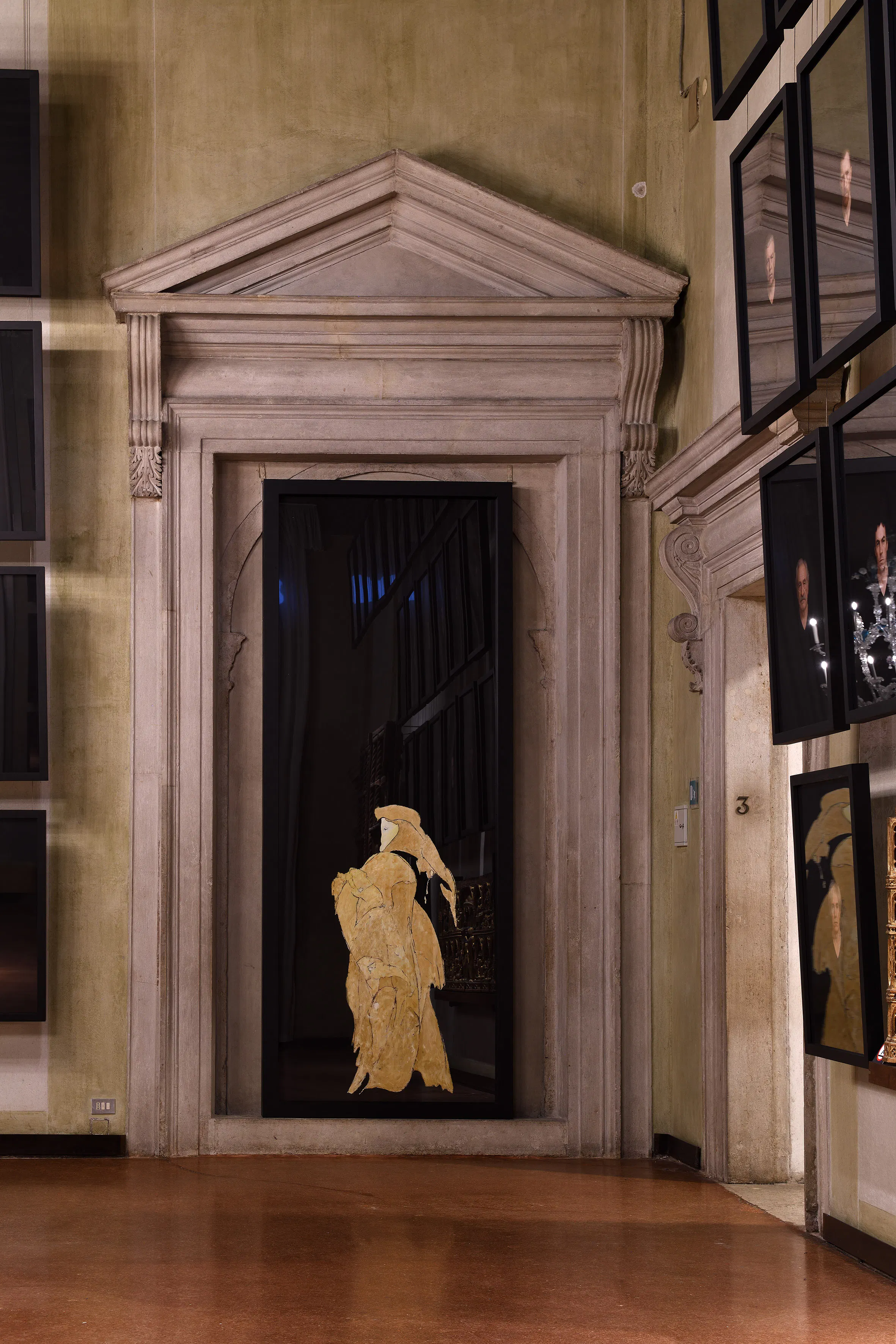
Credits: Michele Alberto Sereni
It is within this suspended eternity that the ninety witnesses appear.
Reflected to infinity, they announce the gathering of the inhabitants of fate in a place and time of the universe without beginning and without end.
Here, universal time seems to take on a tangible form.
It thickens in space.
The artist summons the history of art and reawakens it through a profoundly contemporary gesture.
The image is reconfigured by artificial intelligence.
AI — another threshold.
Archive, memory, and vision intertwine, allowing the portraits to return as surfaces of reappearance.
The past returns within the present, allowing each face to emerge from an eternal depth.
Not as memory.
As presence.
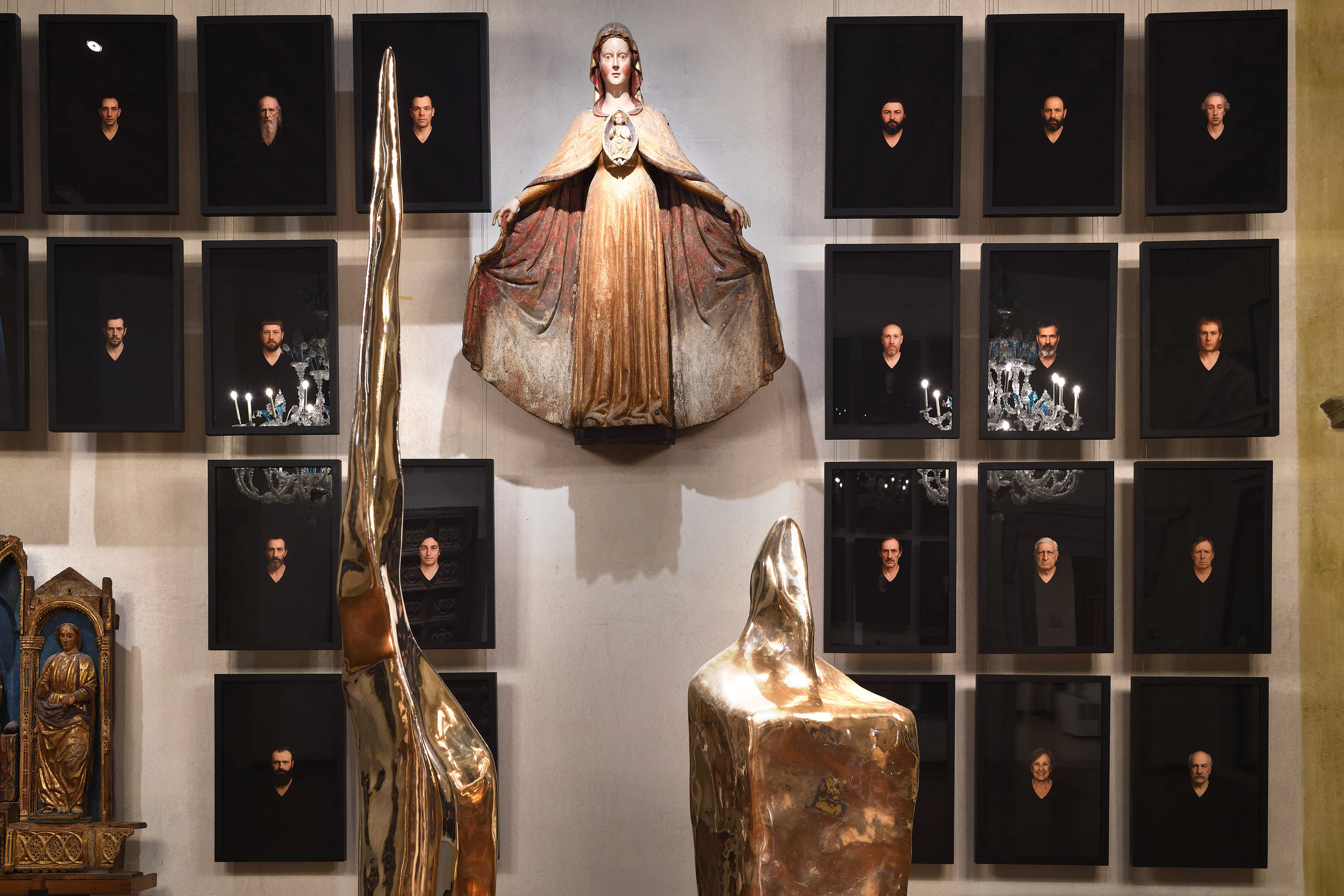
Credits: Michele Alberto Sereni
They retain a reflective quality.
Light.
Gazes.
Space.
Bassiri suggests that the work does not mirror the world, but its own origin.
Every specular condition generates a new image — a sudden coincidence that expands the landscape of thought.
Intuition unfolds into that rare alignment in which thought and vision coincide.
Approaching the portraits, something vertiginous occurs: the image becomes a space one enters.
The portrayed face and the living face overlap.
The observed figure becomes a mirror.
The viewer becomes double — double and specular, as the artist suggests.
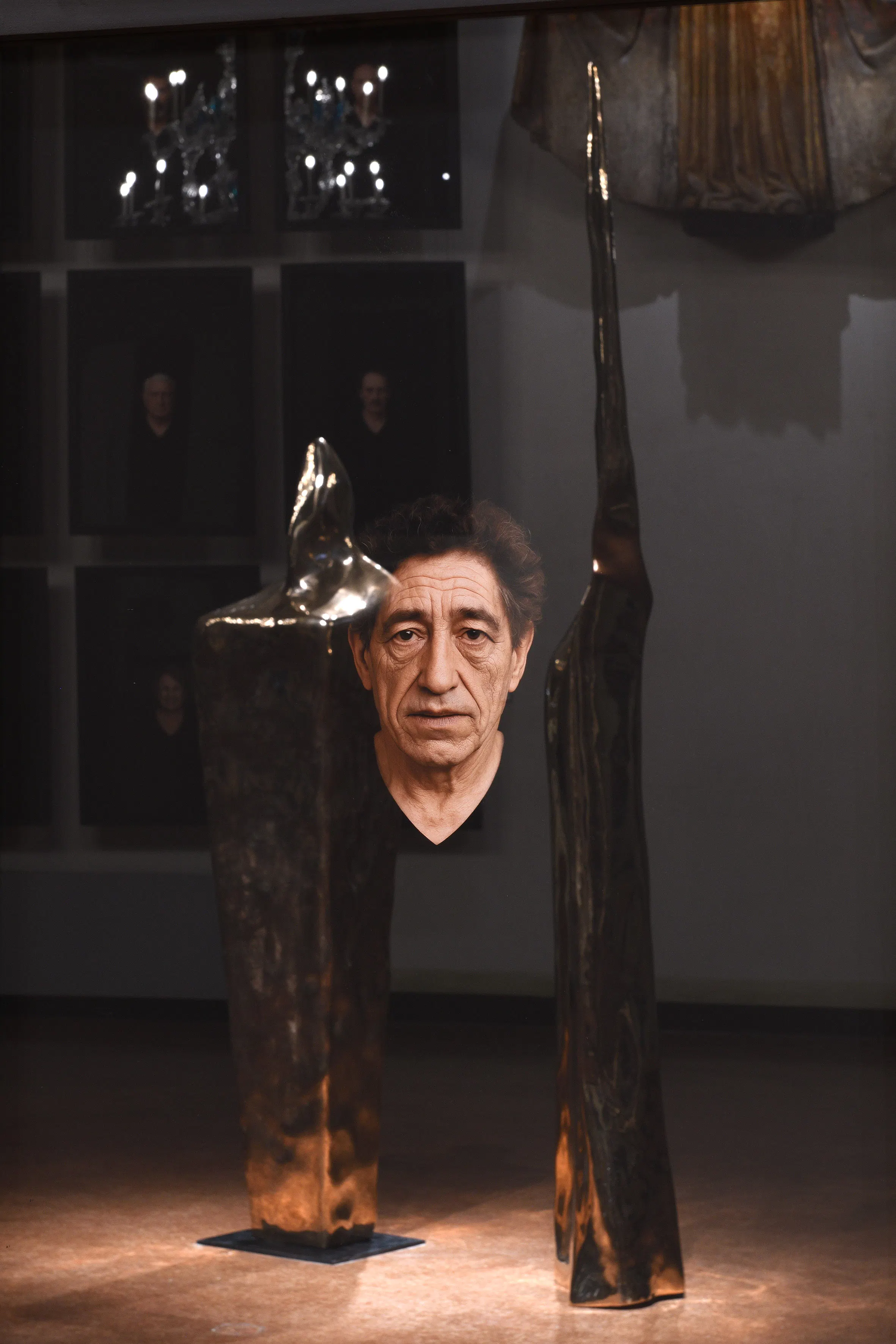
Credits: Michele Alberto Sereni
From wall to wall, reflections chase one another.
Perspective dilates.
The room multiplies.
The work discloses a liminal space.
Between memory and presence.
Between life and death.
Between what has been and what continues to call.
The artists evoked here belong to history.
Yet they re-emerge as suspended.
Presences still active.
A silent choir.
Ninety voices held within the resonance of this matter.
Within it, the Nightwalker assumes an initiatory character.
The Prince crosses the night of knowledge.
He walks within the magma of thought.
He guards the threshold.
He ignites before the word and inhabits the time of intuition:
that suspended time in which the mind approaches nascent form and responds with a still incandescent vibration.
The meteorite remains at the centre like a dark heart.
Primordial intuition.
Credits: Michele Alberto Sereni
Bassiri recalls that within lights, waters, ropes, and trunks —sustaining an infinity of stories built with ardour — vision dilates in exponential acceleration.
It does not lose heart in reflections, and it is never identical in any particle.
Within this shimmer, Venice itself emerges as a device.
It too is reflective matter.
A grammar of light and shadow.
A liminal city suspended between water and stone, between memory and apparition.
The lagoon reflects the sky.
Stone holds time.
The narrow streets become passages.
Thresholds.
Slow trajectories in which the visible coexists with what continues to emerge.
To cross the exhibition ultimately means to cross the city.
Or perhaps to remember that Venice itself is a magmatic thought — an underground energy that continues to generate forms.
A city that remains sovereign without appearing subject to time.
A city nourished by that very time.
Digging downward into consciousness — into the abysses and reliefs of the imaginary — and at the same time rising upward into the sky of humanity, the artists arrange themselves like stars capable of orienting those who dare raise their gaze.
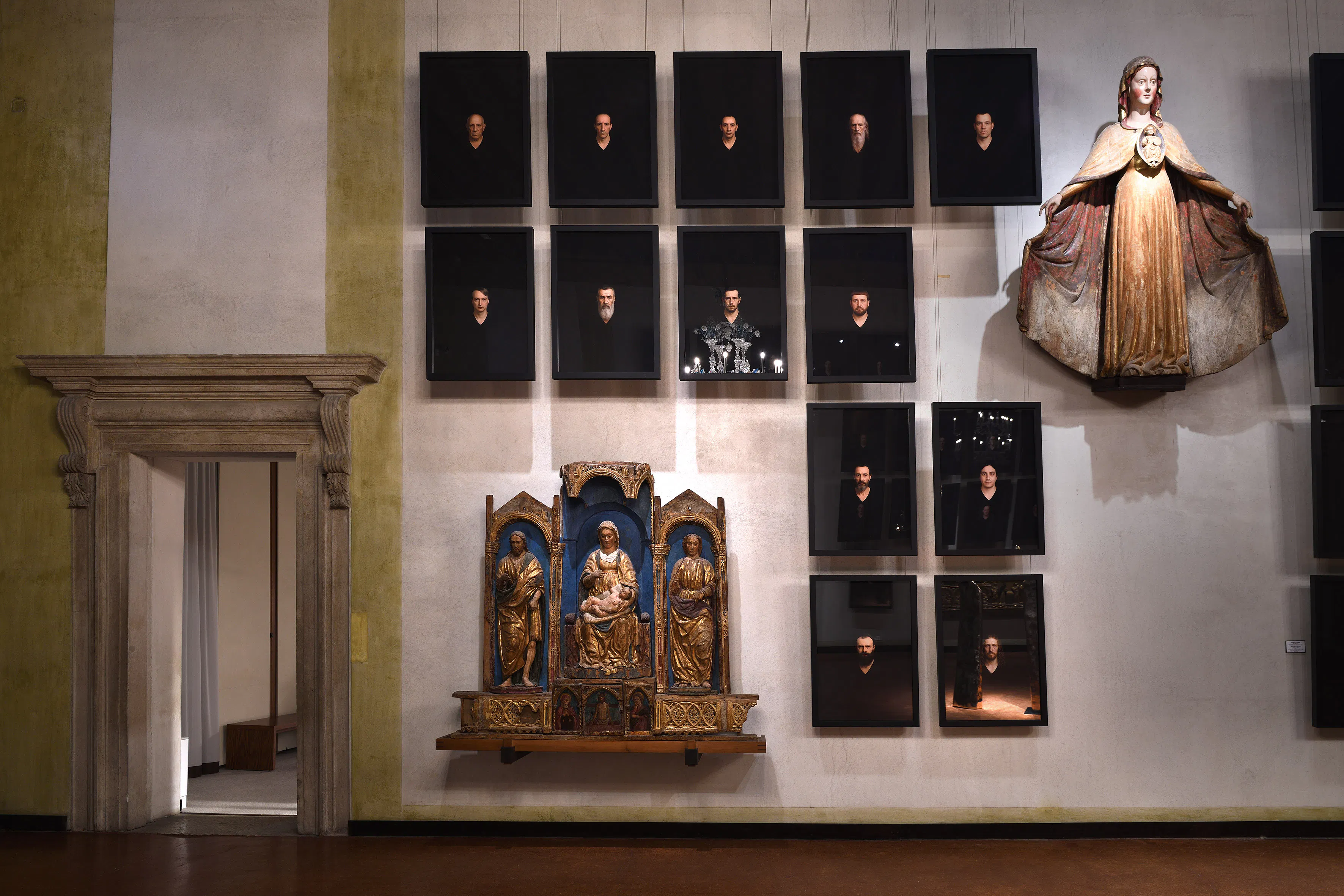
Credits: Michele Alberto Sereni
Days after the visit, the work continues to echo quietly.
It exceeds what vision alone can hold.
It digs into the underground of thought.
It slowly sediments within consciousness like matter that continues to transform itself.
It remains.
Not only as individual memory or a threshold of the gaze,
but as an organic tissue beyond time, holding the quality and energy of the whole.
Artist.
Portrait.
Viewer.
Three trajectories meeting like an invisible line that crosses centuries.
And for an instant, an almost perfect coincidence aligns them in the same point of light.
The Nightwalker of Magmatic Thought appears as a possible form of truth.
A truth that does not impose itself.
It ignites.
It triggers reflection.
It activates questions.
It opens that endless condition — generated by the light that emanates from the intention of the work itself — in which images continue to produce meaning beyond the time of their appearance.
Among the portraits, among the lights and shadows of Museo Correr, in the present and in memory, an echo continues to resonate.
The vibration of magma.
A current moving through images and bodies.
This constellation of presences continues to summon time.
A slow time.
Persistent.
Silent.
There the Prince advances — where matter, intuition, and destiny return to generate themselves.
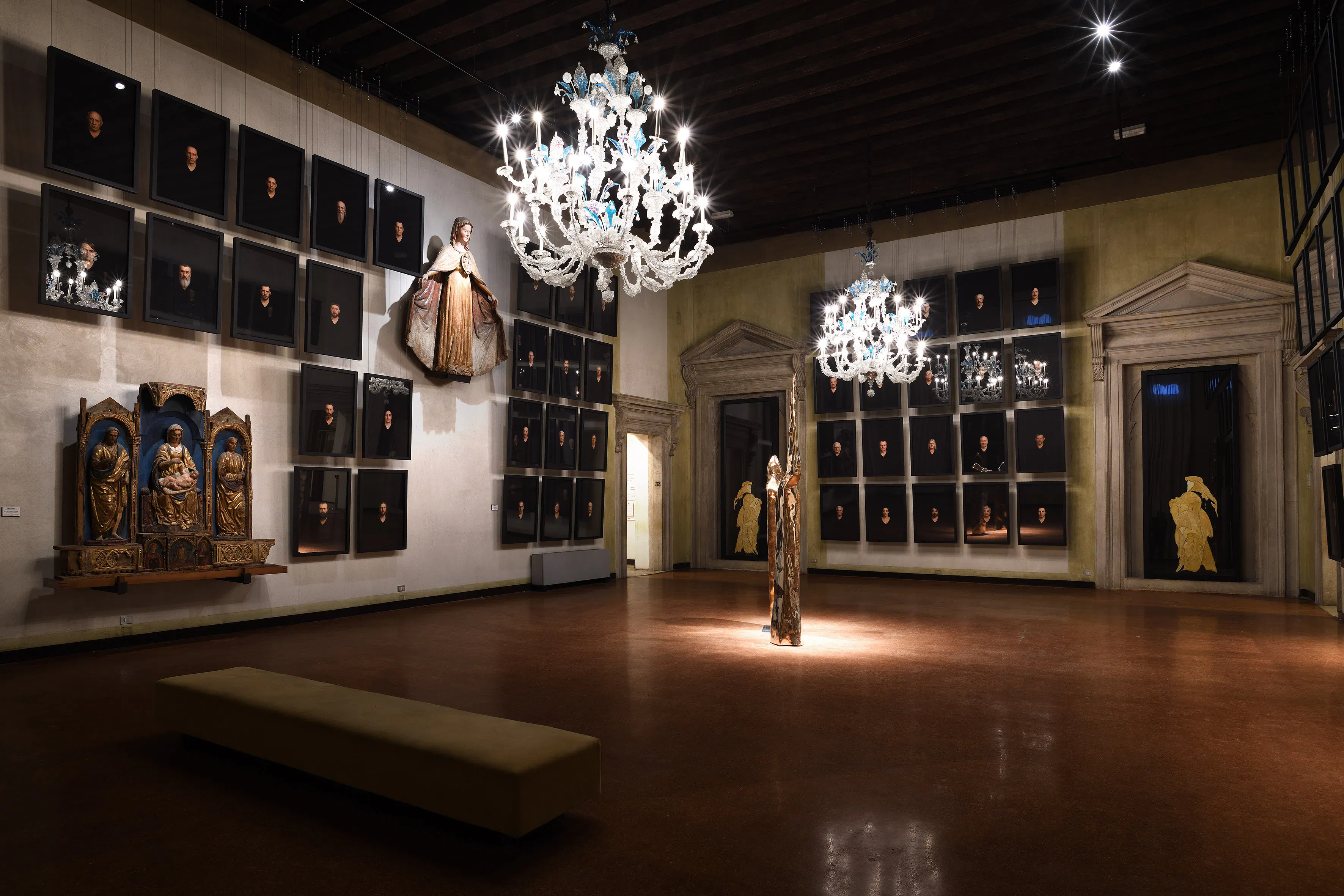
Credits: Michele Alberto Sereni
The Prince. The Nightwalker of Magmatic Thought.
Sala delle Quattro Porte, Museo Correr, Venice
27 February – 22 November 2026
Curated by Chiara Squarcina and Bruno Corà
In collaboration with the Fondazione Musei Civici di Venezia