echoes
Fragments in Minor Keys
Samia Halaby —
On Abstraction as Resistance
Conversation between Samia Halaby and Francesca Carol Rolla
London, Frieze Art Fair, October 2025
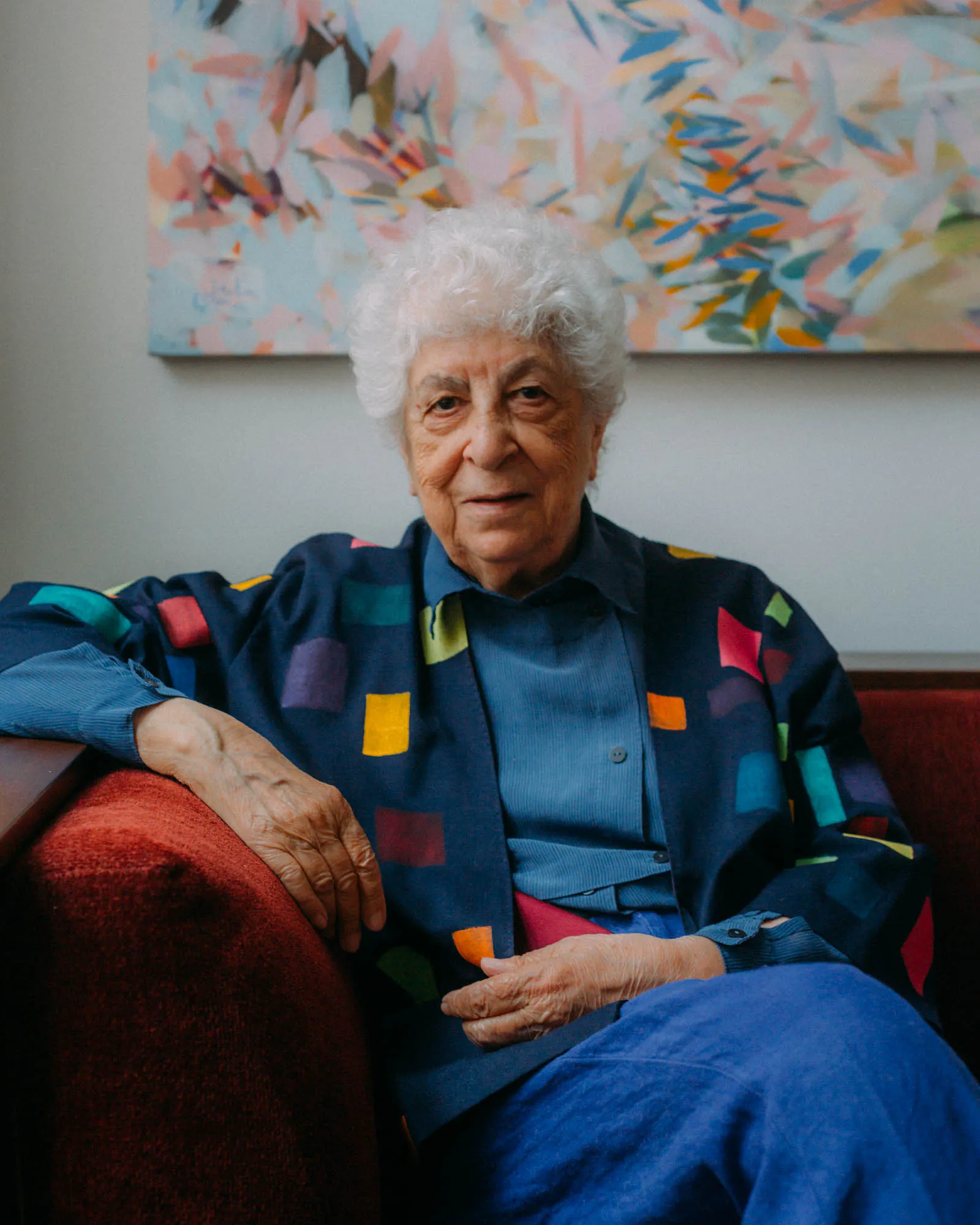
Photo by Daniel Terna
Courtesy the artist & Sfeir-Semler Gallery
Samia Halaby (b. 1936, Jerusalem) is a Palestinian American artist and scholar living and working in New York. Her most recent exhibitions include the Whitney Biennial, New York (2026), the Diriyah Contemporary Art Biennale, Riyadh (2026), and the Hyundai Card First Look: Samia Halaby, Museum of Modern Art, New York (2025). Her work is in the collections of the Museum of Modern Art, New York; Tate Modern, London; Centre Pompidou, Paris; the Guggenheim, New York and Abu Dhabi; Lenbachhaus, Munich; the Smithsonian Museum of American Art, Washington; the San Francisco Museum of Modern Art and many other public and private collections. In 2025, Halaby was honored with the MUNCH Award for artistic freedom. In 2024, the jury of the Biennale Arte in Venice awarded her a Special Mention in recognition of her longstanding work.
FCR: Art, abstraction and activism — these are large and often conflated terms. I would like to understand how you conceive the political nature of abstraction in your work. Beyond what we see — beyond the painting, beyond colour, beyond the final form it takes — what is at stake for you?
SH: The relationship between activism and abstraction — or art in general, my art in particular — is central to my thinking.
When I was first beginning, quite young as an artist — not as a student, but soon after — I was asked: “Where is Palestine in your work?” I remember a young man asking me that at my first small show in New York. There was political momentum, and everyone in Palestine was pushing toward the political revolution, the Intifada. Many felt that every Palestinian artist must have the cause in their work.
My response was to pause and ask myself: who is asking?
I analysed three different forces around me asking that same question. There was the young revolutionary, very enthusiastic. He wanted Palestine in my work. Then there was the Arab bureaucrat who wanted a bit of calligraphy to show his Arab heritage in his office. And then there was the American imperial bourgeoisie who sought to place me in a depoliticised subcategory — to reduce me to a minority, to send me back to my “roots.” In other words, they wanted to confine me to a backward glance at history rather than allow me a forward-looking one.
So, I developed an answer for each of them.
With maturity, I came to think of art simply as a means, a craft. The way I place a brush mark on a painting, the way I mix my colours, along with an understanding of the chemistry of colours, the physics of light, and how the eye sees, all lead to methods for using materials properly and for constructing illusion. The creation of illusion is the language of painting.
Art is a method for making something. We speak, for example, of the art of cooking, the art of war, the art of chess.
I use my craft in ways that respond to the questions I admire and support, but primarily to fulfil what is strongest in my aesthetic impulse — to make images that explore the language of illusion with a future-minded attitude.

Between Time and Light, 2023, arcylic on canvas, 149,5 x 446,5 cm
Courtesy the artist & Sfeir-Semler Gallery
One result is my abstract painting, which is where my heart wants to be —
at the leading edge of discovery in the language of images.
That practice is the most political of the three manifestations of my craft.
The other two are documentary pictures and propagandistic ones. I admire and support the young revolutionary who asked me, “Where is Palestine in your work?” I do want Palestine in my work, but not within my search for the future of images — for the future of painting and abstraction. There, I remain committed to being international. As for my love of Palestine, you will find it in my documentary and propagandistic art.
Who is going to see it?
In one branch of my documentary work, I undertook a serious, in-depth documentation of a massacre that took place in Palestine in 1956. In order to make the drawing of the Kafr Qasem Massacre, I imagined myself as a camera recording everything the witnesses described to me — because there were no photographs of the massacre.[1]
Another subject I documented was the olive trees of Palestine and the ways in which the occupation damaged them in order to damage our economy.
The third category consisted of blunt, overt posters that I carried in demonstrations — large banners I made for leftist parties, groups and committees.
I want to return to the fact that my central aesthetic impulse is abstraction, which is, in fact, the most political of the three visual expressions of my craft. And perhaps, in my view, that is also why people respond to them.
Our education does not provide Western audiences with either the history of abstraction or the analytical tools to understand abstraction. Yet viewers nevertheless perceive intuitively. They know — even if they cannot verbalize what they know.
Modern abstraction started with the Impressionists who gave something to the world that had never existed in painting before. They stopped focusing on the bourgeoisie. Their subject matter became the lower middle class, and in some cases, workers. Even more importantly, in terms of language, they began to use brush marks in a way that implied motion. Any advancement in content requires a corresponding advancement in the language that bears it.
For example, five brush marks might suggest five people walking down the street. That expression had never existed before in history. There were earlier kinds of abstraction, but this kind introduced an element of time into the artwork.
Then we had the Cubists and the Futurists. The Futurists spoke about simultaneity — many things happening at the same time.
Then came the Constructivists, who brought these discoveries together. And later the Abstract Expressionists also made a step forward into painterly abstraction.
Each of these movements was like a group of surfers riding the tsunami of working-class revolution and hope that gave rise to intellectual optimism. They mark the true beginning of working-class culture. I count these artists and these revolutions as my primary history — my roots, my responsibility, and my freely chosen hope for the future.
So how is abstraction realistic?
To me, it is just as realistic — perhaps even more so than Renaissance painting — because it incorporates time and motion, imitating the principles of reality rather than picturing it as something static, seen from a single point of view. Renaissance painting was revolutionary in its time and remains profoundly beautiful. However, when I consider it honestly, it feels foreign to me; it does not correspond to the world I inhabit.
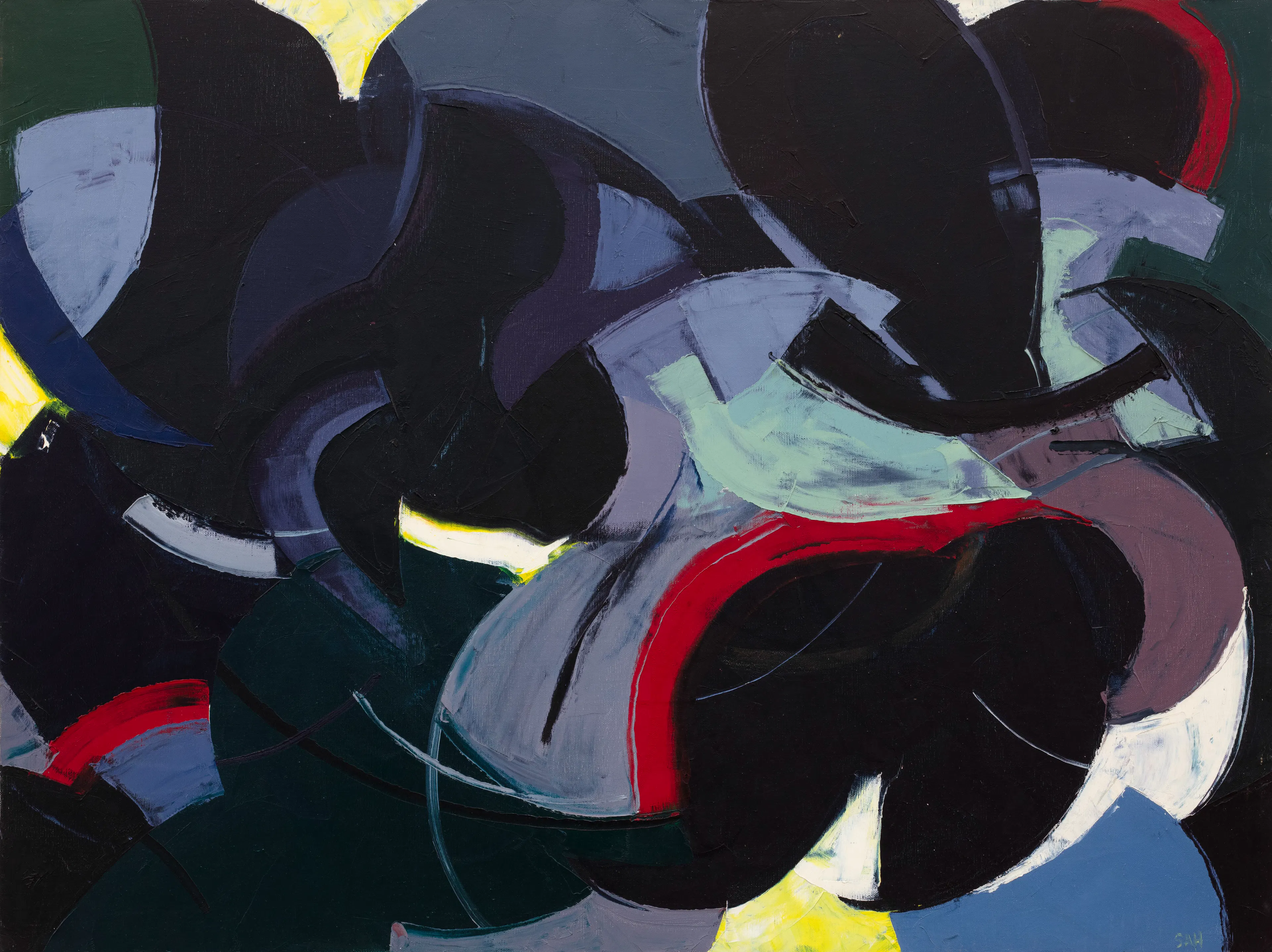
Paradise Gardens, 1985, oil on canvas, 76,2 x 101,3 cm
Courtesy the artist & Sfeir-Semler Gallery
FCR: When you were asked “Where is Palestine?”, there was an expectation of representation. Sometimes reality itself can be overwhelming. Could abstraction be a way to challenge imposed narratives? If we think of dominant myths — Western art, the myth of the artist as genius — does abstraction open a political and social space to articulate one’s own experience, beyond imposed representation?
SH: You make a very good point. Yes. I am refusing to represent the narrative they are creating for me.
There is another important point that connects to this: I was not born a victim. I am a fully qualified member of humanity. And that is how I see myself. What I value most is how viewers of a more enlightened future will see me.
What I find interesting is that what you recognize in my work is not me; you recognize your own experiences. What matters is that I have provided a visual language which allows us to share insights.
Historically, art has not been about self-expression.
I believe our responsibility is
to be part of society —
to listen to what surrounds us, to discern the direction of the future, and then to extract principles that we had not previously imagined.
FCR: That resonates with what you said earlier — that each brush mark, as in Impressionism, makes sense only in relation to others. Taken alone it may signify something, but it acquires meaning within a larger field.
SH: Exactly. From Josef Albers we learned the relativity of colours to each other. And from Einstein, the relativity of depth and space. These elements that create movement in the artwork are things we all experience.
But who is society?
I am a member of it.
It has ancestors, memory, progress.
There is a social ambiance we are part of.
Who is my society?
All that I am familiar with — not only Palestine.
And the same is true for everyone.
The artist is simply sensitive to this moving, amazing entity we call reality — always changing.
And I am part of it. That to me is cause for celebration.
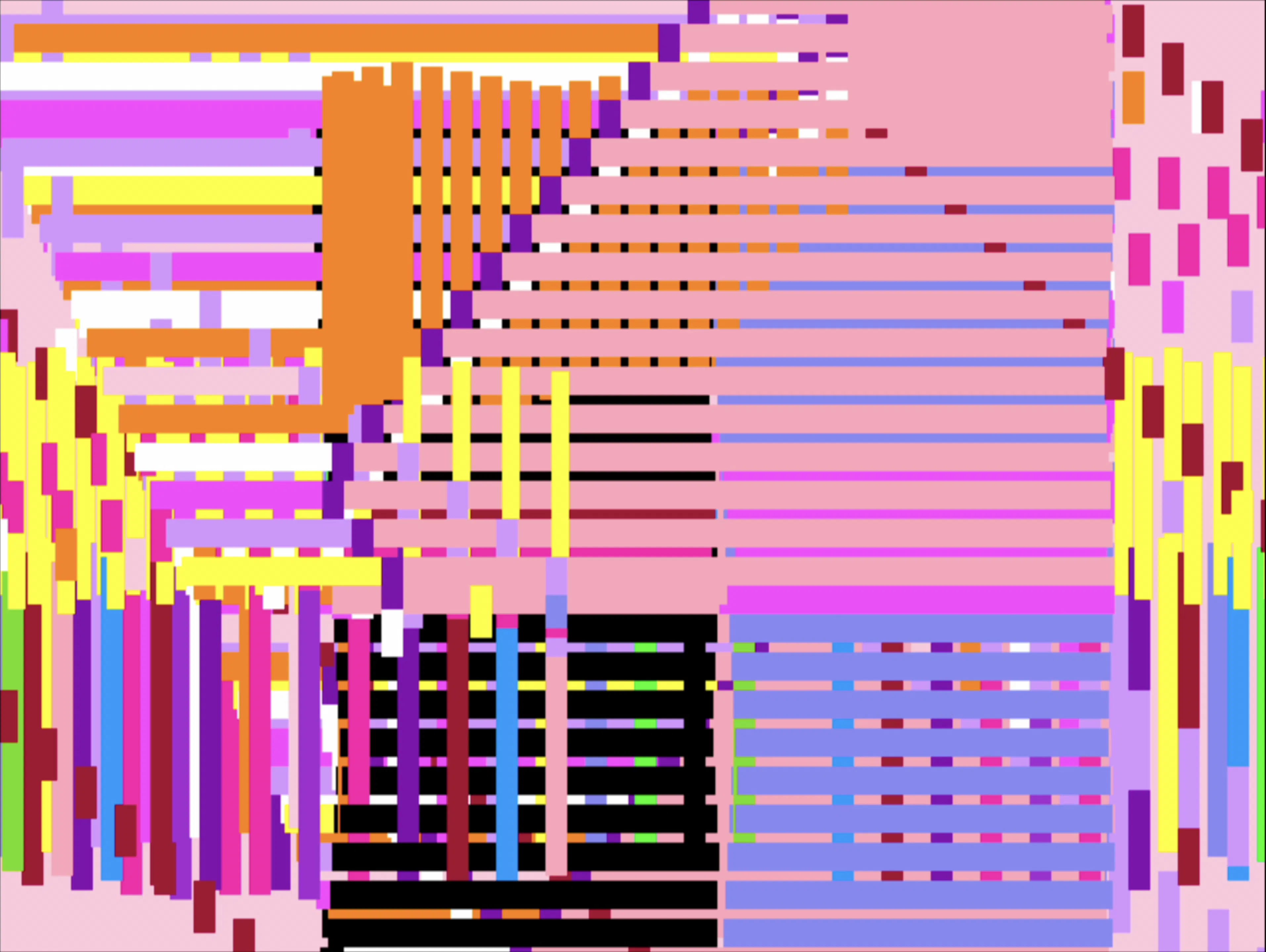
Weavings, Kinetic painting programmed on an amiga computer, 1987, 32s
Courtesy the artist & Sfeir-Semler Gallery
FCR: The language of art then becomes not escape, but a language of freedom — a return to communication, to how we express ourselves individually and collectively. Could this be why your work functions as a mirror for so many people, beyond origin or identity?
SH: Yes, exactly. Thanks for the words you chose to express it.
FCR: I find my place in what you do because I feel like one of those brush marks — part of the same field.
SH: I like that very much.
When people say that art is self-expression, I consider that a form of propaganda. There is another piece of propaganda as well: the notion of influence. Artists are often accused of being influenced, as if that implied a lack of originality. But influence is the very essence of learning and of belonging to society.
The creative process depends on a balance between intuition and conscious knowledge; both are rooted in experience. Certain elements emerge in a painting, and we recognize them as beautiful. Sometimes we artists are lucky, and the painting resolves itself with assurance. At other times, it resists and gives us considerable trouble.
In my recent work, I may begin with an idea — perhaps to make a very pale painting, or a blue one — yet the result is often different from what I intended. I do not always succeed. I blame failure and the trouble I encounter in painting on an imperious consciousness that does not listen to intuition.

Courtesy the artist & Sfeir-Semler Gallery
FCR: At this point, it may be useful to ask: what does pedagogy have to do with abstraction, politics, and the question of influence? Teaching became another site in which reflections on perception, consciousness, reality, and responsibility could be tested and transmitted in practice — not only through painting, but through the formation and development of thought in young artists and thinkers.
SH: My teaching developed alongside my maturation as a thinker and artist. Teaching was very liberating during my early years teaching in Hawaii and the Mid-West. I could be inventive. Later, when I moved to New England, I began applying my political thinking more consciously to my artwork. I became more focused and more creative in the projects I presented to students.
The more radical my thinking became, the more I encouraged students to become conscious of how they see as they move. I once asked them to walk down the street, back and forth, and from that experience create a single still painting of what they saw. I was teaching them algorithmic thinking — how to look at reality and extract general principles from it.
I enjoyed my students because I learned a great deal from them, especially first-year students, before university conditioning affected them.
You experience the world. You see a sunset. You swim in a river. You want to paint.
Then the discourse of self-expression and influence takes over.
But you have to free your mind first.
You have to tell your intellect to obey your intuition.
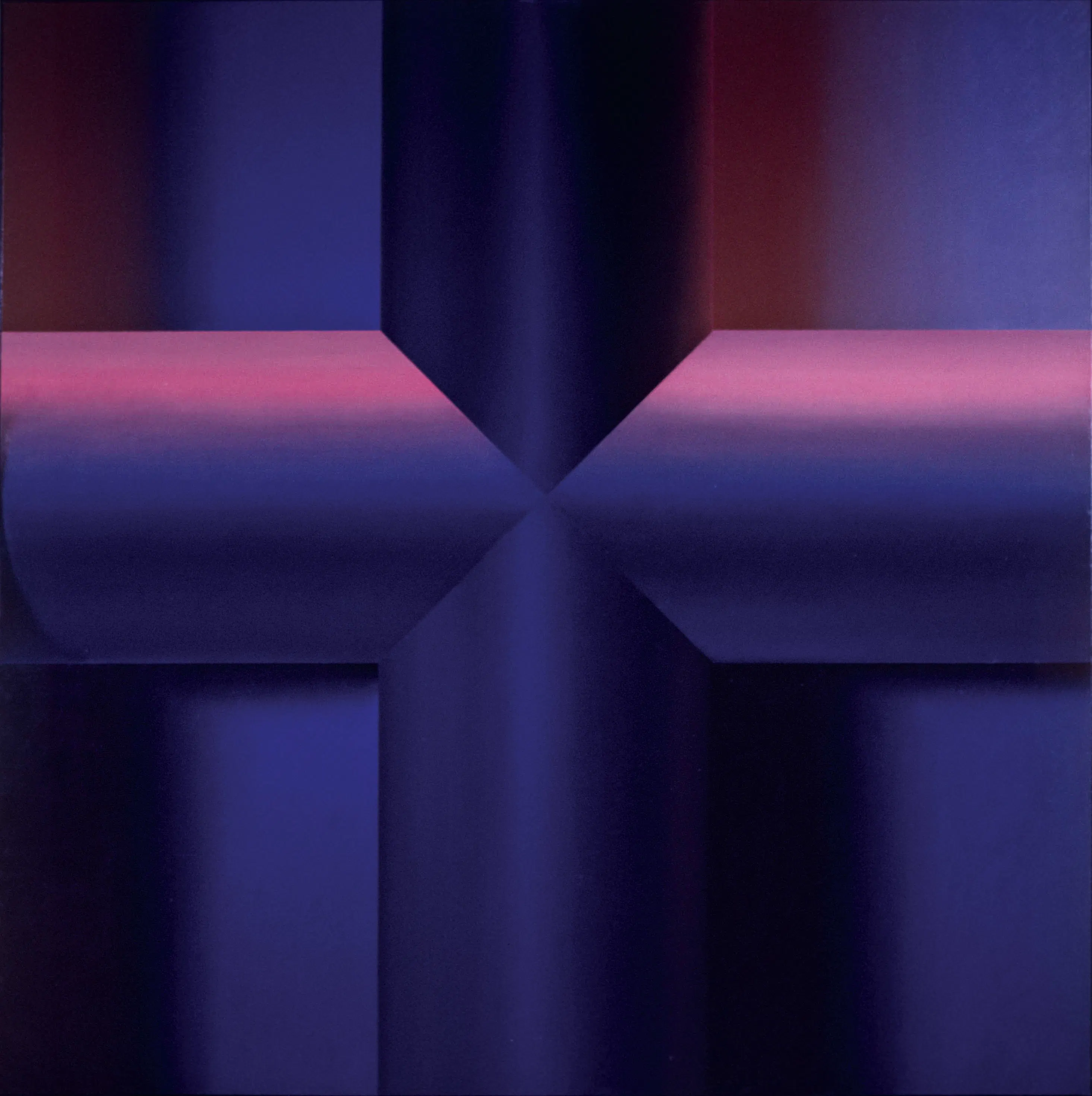
Black is Beautiful, 1969, oil on canvas, 167.5x167.5cm
Courtesy the artist & Sfeir-Semler Gallery
FCR: When you became politically conscious, how did that shift your understanding of liberation — and how does that awareness live alongside your commitment to abstraction?
SH: In my own consciousness, I never felt inferior to men. But when you examine society, you experience its limitations and contradictions. Gender disappears when one explores the history of human culture. I become a body-free piece of consciousness traversing the huge landscape of history. My intellect was simply my intellect. I presumed everyone’s intellect was equal.
When I became
politically conscious,
I saw women’s liberation, national liberation,
religious freedom —
all forms of liberation —
as interconnected.
If I have any feminism, it would be radical feminism. I once made a poster quoting Lenin: "To free women is to free society." I like how this makes us see the interconnectedness of all liberation movements and their global nature.
People do not know that this painting is a woman’s work. They simply see an artwork.
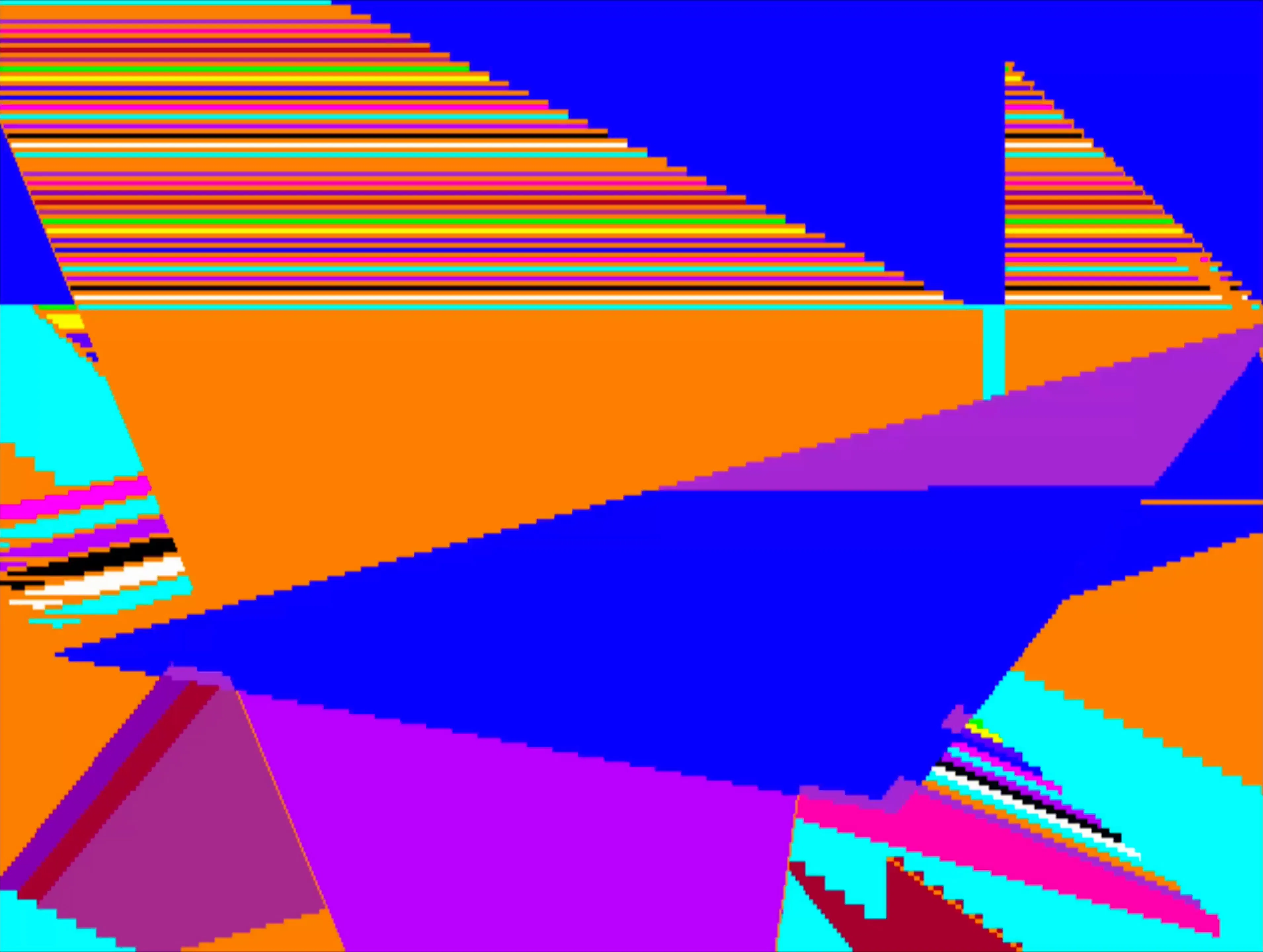
Bread, Kinetic painting programmed on an amiga computer, 1988, 31s
Courtesy the artist & Sfeir-Semler Gallery
FCR: Some conversations do not conclude; they remain open fields.
SH: That was a good conversation. Thank you.
It was a pleasure meeting you, Francesca.
[1] Samia A. Halaby, Drawing the Kafr Qasem Massacre (Amsterdam: Schilt Publishing, 2016). An Arabic translation was published by the Institute of Palestine Studies.
echoes is a curatorial project conceived within We Exhibit and curated by Francesca Carol Rolla. It brings into relation art, culture, and memory through encounters and practices of listening, where voices from contemporary art, critical thought, and research intersect.
Learn more about the project on the dedicated page of our EDITORIALS edition.